What a Perfume Sample Costs, Line by Line
A sample is never just a small bottle of juice. It bundles perfumer time, raw materials, pack prototypes, testing and freight, and the number at the bottom of the quote usually covers only part of that. The first thing a buyer should do is make the supplier split the one-off development fee from the per-unit production price, because the two behave completely differently once volume arrives: development cost falls per unit as volume grows, and production cost does not move at all.
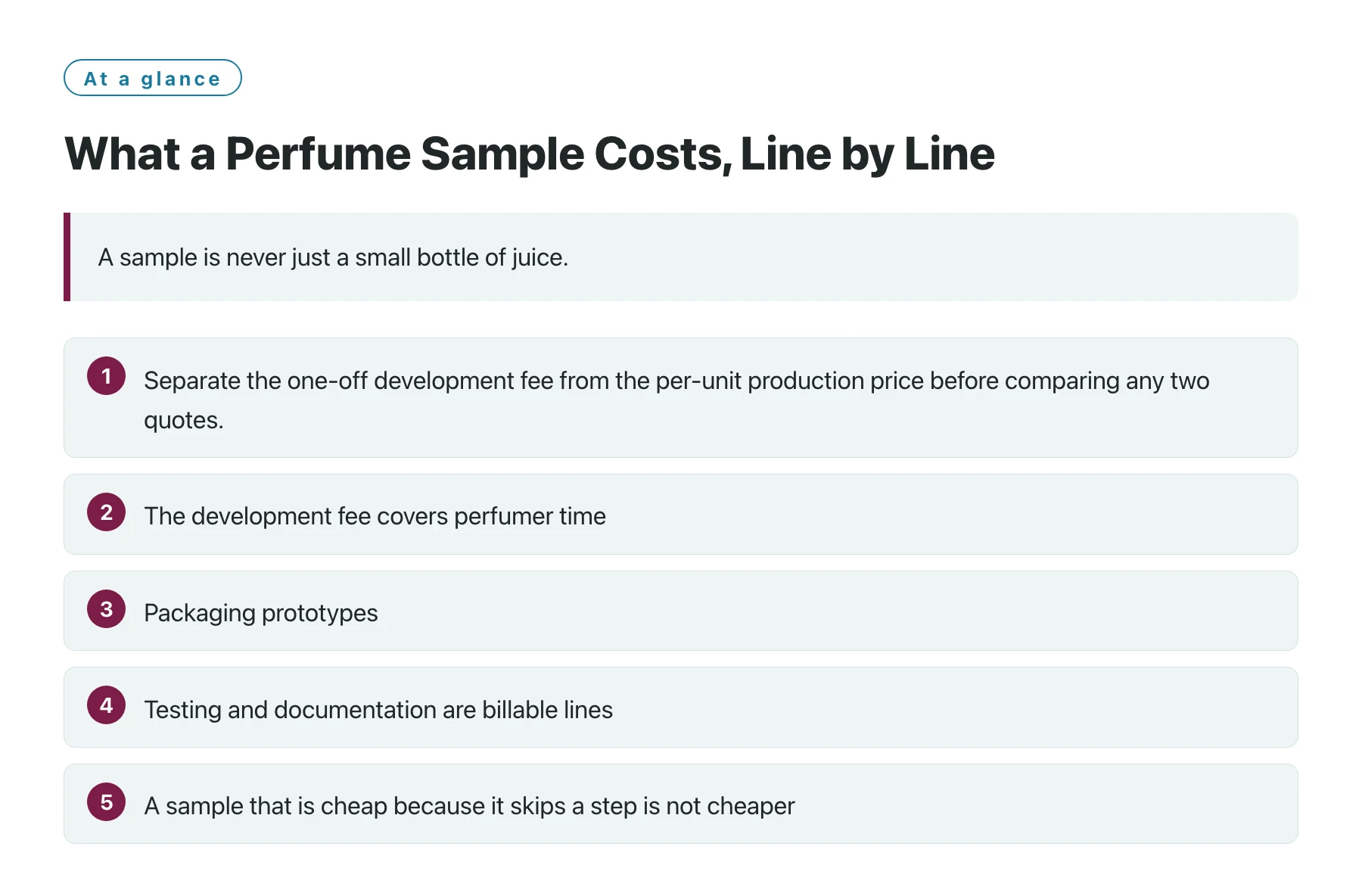
Key takeaways
- Separate the one-off development fee from the per-unit production price before comparing any two quotes.
- The development fee covers perfumer time, trial materials and the number of revisions the supplier is willing to absorb.
- Packaging prototypes, tooling and decoration samples are usually billed outside the sample price and are frequently the largest surprise.
- Testing and documentation are billable lines, so ask which tests are included and which are quoted separately [1].
- A sample that is cheap because it skips a step is not cheaper, it just moves the cost to the point where it is most expensive to fix.
Quotation comparison is where a fragrance project is quietly won or lost. Two suppliers can quote the same sample at very different prices and both be honest, because they are not quoting the same thing.
The confusion is structural. A sample order contains development work that will never be repeated and production work that will be repeated thousands of times, and suppliers bundle them into a single figure for convenience. Unbundling it is not a negotiating trick; it is how you find out what the product will actually cost.
This applies whether the brand is buying an off-the-shelf base with a new label or commissioning a development from a brief.
Why two sample quotes rarely mean the same thing
One supplier may quote a development fee plus a unit price, another may quote a flat sample charge, and a third may not charge for the first sample at all because the cost is built into the production price. All three can be reasonable commercial positions, and none of them can be compared to the others without being converted into the same shape.
The conversion is simple: ask for the total cost of getting to the first sellable unit, at a stated volume, including tooling, decoration, testing and freight. That figure is the only number that is comparable across suppliers, and it is the number the launch budget actually needs.
A quote also has a date. Material and freight costs move through the year, and the beauty trade press follows those movements closely enough that two quotations issued months apart cannot safely be treated as a like-for-like price comparison [2].
One-off versus per unit
Development work does not scale. A perfumer who spends two weeks building a base has spent two weeks whether the order is 1,000 units or 50,000, so the cost per unit of that work falls as volume rises. Production does scale, but only in steps: a filling line, a decoration method and a packing format each have their own economic floor.
Keeping the two categories apart in your own spreadsheet makes the negotiation clearer. If the per-unit price is the problem, ask about pack components, filling method and order quantity. If the development fee is the problem, ask what work packages are included.
What the brief itself costs
A vague brief is expensive, because the perfumer has to search a wider space and the trial count goes up. Briefs that name a reference direction, an intended market, a price ceiling and the materials that must be avoided typically reach an acceptable sample in fewer rounds, and fewer rounds is the cheapest saving available to a buyer.
The lines that make up a sample bill
| Cost line | What drives it | One-off or per unit | Where it hides |
|---|---|---|---|
| Perfumer time | Whether the brief starts from an existing base or from a blank sheet | One-off | Absorbed into the sample price with no line of its own |
| Trial materials | Number of trials, and any materials that are expensive or restricted | One-off | Usually not itemised |
| Pack prototypes | Bottle, cap, pump and carton samples, and whether tooling exists already | One-off | Often quoted after the juice has been approved |
| Decoration samples | Printing, hot stamping, coating or labelling trials | One-off | Sometimes billed per trial run, not per design |
| Testing | Which tests are required for the destination market and by whom they are run [1] | One-off or per batch | Frequently excluded 'pending testing' |
| Filling and freight | Order volume, fill format, destination and shipping mode | Per unit | Quoted separately once volume is known |
The fourth column is the one to read twice. Missing lines are not discounts; they are costs that have been moved to a later invoice, and by then the project has fewer options.
Three ways a cheap sample becomes an expensive launch
The first is a sample price that excludes the pack. Juice is approved, tooling is opened, and only then does the cost of the bottle and the decoration arrive. The second is an unrealistic revision allowance: a low development fee that covers one trial tends to become three paid trials. The third is research that has to be repeated because the first base proved impossible to produce at the target cost.
There is a cost question worth asking early, even though it is uncomfortable: what does the supplier expect the landed unit cost to be at the volume you actually plan to order? A partner whose business is Xuelei perfume manufacturer should be able to answer that with a range, and if the range does not fit the brand's price architecture, it is better to know before the first sample than after the third.
Where quotes hide cost
Watch for the words 'pending', 'not included' and 'by others'. Each one moves a line off the quote and onto the project. It is fine for a supplier to exclude something, as long as the brand knows what it will cost to buy it elsewhere. where a perfume quote can hide costs treats the same problem from the production side and is a useful second opinion before signing.
Cost is not only money
A cheaper supplier who adds three weeks to every round is not cheaper for a brand with a fixed launch window. Put a notional value on the calendar: if a three-week slip costs a season, that slip belongs in the cost comparison.
Questions that change the number
- How many revision rounds does the development fee include, and what does an extra round cost?
- Is the bottle a stock item or a new mould, and who owns the mould?
- Which decoration methods are available in house, and which are subcontracted?
- Which tests are quoted, which are excluded, and who submits the samples?
- What is the minimum order quantity for the price on the page, and at what volume does it step down?
- What is included in the sample freight, and what is charged at production volume?
- If the formula has to change for compliance reasons, is that a new development fee?
Ask every supplier to quote the same written scope, and to mark each line as one-off or per unit. Two suppliers answering the same page are comparable. Two suppliers answering their own questions are not, no matter how tidy the quotes look.
Sources
- SGS: Cosmetics, Personal Care & Household Testing —— Testing, inspection and certification services for cosmetics and personal care, including microbiological, stability and safety testing aligned with cosmetics GMP.
- Cosmetics Business —— A trade publication covering the beauty and cosmetics industry, including fragrance launches and regulatory developments.
Frequently asked questions
Should I expect to pay for a first sample?
Often yes, especially when the brief requires development work or a custom pack decision. Some manufacturers credit part of the sample charge against the first production order. Ask what happens to the fee if the order is placed, and what happens if it is not.
How much of a sample cost is the juice itself?
Less than most buyers assume. Perfumer time, packing prototypes, tooling and decoration trials typically dominate a sample bill, which is why optimising the concentrate before the pack is settled rarely delivers the saving people expect.
Why do quotes from two factories differ so much?
Usually because the scope differs rather than because one is overcharging. Different revision allowances, different pack components, different test lists and different order quantities all move the number. Normalise the scope first, then compare.
Does a bigger order always reduce the unit price?
It reduces the one-off cost per unit, and it may unlock a lower production price if the volume crosses a method or tooling threshold. Below that threshold the production cost per unit is broadly flat, so a larger order mainly spreads the development work.
How should I treat tooling in the budget?
As a separate, non-recurring line with an owner. Decide whether the brand or the supplier pays for it, who holds the tool, and what happens to it if the relationship ends. Tooling treated as a rounding error in a sample quote becomes a stranded asset later.