Live Mining Statistics for Due Diligence on a New Pool
A pool's statistics page is the only part of its pitch you can check independently, and it is enough to rebuild the income claim yourself. With network hashrate near 1,003 EH/s and difficulty at 132.76 T, a 200 TH/s machine should earn about 0.0000897 BTC a day — $7.60 at $84,692 — and any pool whose numbers imply materially more or less than that is telling you something the interface does not.

Key takeaways
- Rebuild the claim: at 200 TH/s the expected daily output is about 0.0000897 BTC at today's difficulty, before any fee.
- Pool hashrate divided by network hashrate gives expected blocks per day — a pool at 30 EH/s should find roughly 4.3 blocks a day of the 144 the network produces.
- Payout cadence and fee composition matter more than pool size: a listed 4% on the PPS-settled block reward and 2% on the transaction-fee component is not the same as a flat percentage of all income.
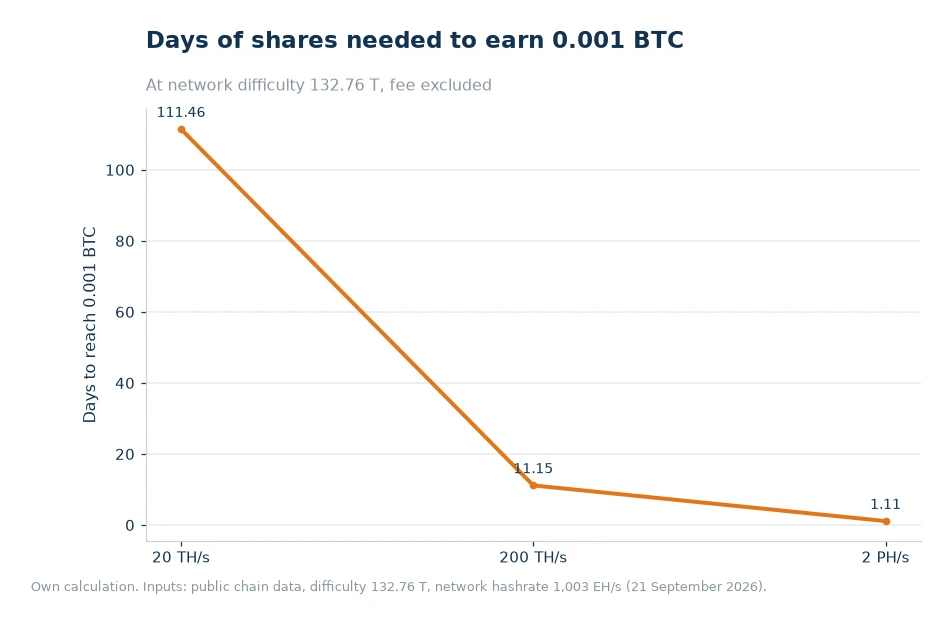
- Reaching 0.001 BTC takes about 1.1 days at 2 PH/s, 11 days at 200 TH/s and 111 days at 20 TH/s.
The short answer
Four published series are enough for meaningful due diligence: pool hashrate, network hashrate, difficulty and miner count, plus the fee schedule and the payout method. From those, expected income, expected block rate and expected settlement frequency can all be derived, and the results can be compared with what a running miner actually receives. Everything else on the page — rankings, charts, activity feeds — is presentation.
How the mechanism works
Start from the network. Bitcoin creates 3.125 BTC per block and targets 144 blocks a day, so the network pays out 450 BTC a day — roughly $38.1 million at $84,692. Any miner's expected output is their share of network hashrate multiplied by that 450 BTC. The pool adds one more step: it aggregates shares, finds blocks, and distributes rewards according to a payment mode.
Because a pool's expected block rate is simply its share of network hashrate times 144, the statistics page can be checked against reality. A pool reporting 30 EH/s of its own hashrate is 2.99% of a 1,003 EH/s network, which implies about 4.3 blocks a day and therefore about 13.5 BTC a day of block subsidy across all its miners. If a miner knows their share of that pool, their expected income follows in one multiplication.
| Your hashrate | BTC per day | USD per day | USD per day after the listed 4% | Days to 0.001 BTC |
|---|---|---|---|---|
| 20 TH/s | 0.00000897 | $0.76 | $0.73 | 111 |
| 200 TH/s | 0.0000897 | $7.60 | $7.29 | 11.1 |
| 2 PH/s | 0.000897 | $75.99 | $72.95 | 1.1 |
Two details in that table are worth saying out loud. First, the 4% column applies to the block-reward component only; the transaction-fee component follows PPLNS logic at a listed 2%, so the blended haircut on total income is smaller than 4% in most conditions. Second, the days-to-target column is a straight-line estimate at one difficulty setting, and difficulty moves roughly every two weeks — the next adjustment was estimated at -2.12% when this was written, which would improve every row slightly.
Where miners get it wrong
Confusing pool size with pool performance. A larger pool lowers payout variance because blocks arrive more often, which is a cash-flow property. It does not raise expected income; your share of network hashrate sets that. A 200 TH/s machine earns the same expected $7.60 a day in a pool with 4 blocks a day or in one with 40.
Reading a partial-period hashrate as stable capacity. Live pool hashrate fluctuates with miner migration and with the difficulty cycle. Checking a single snapshot once is not due diligence; watching the same series across a full difficulty round separates a pool that is growing from one holding its share.
Ignoring the settlement rail. Hourly settlement against current difficulty is a PPS+ behaviour. A pool that only distributes after blocks confirm will look identical on the statistics page and behave completely differently on your invoice dates.
Skipping the payout threshold. At 20 TH/s, expected income is 0.00000897 BTC a day, so a threshold set for industrial miners can delay a first payout by months. The threshold belongs in the same comparison as the fee.
A checklist you can run today
- Capture four numbers. Pool hashrate, network hashrate, difficulty and miner count, read at the same moment. Everything else is derived.
- Compute expected blocks per day as 144 × (pool hashrate / network hashrate), and compare it with the block history shown on the page.
- Compute your share as your hashrate divided by pool hashrate, then multiply by the pool's expected daily subsidy. That is your income before fees.
- Apply the fee to the right component. Use the published breakdown rather than a single blended percentage.[1]
- Check uptime and latency. Global node coverage and a nearby endpoint matter more than a marketing line: rejected shares are lost income and no fee schedule compensates for them.
- Confirm coin coverage. If the plan is to switch a rig between chains later, verify that merged mining and multi-coin support are there before moving hardware.
Doing this once takes about half an hour, and the arithmetic carries over to any pool. An income calculator reproduces the same result from coin price, difficulty, fee rate and valid hashrate, including merged-mining output — useful as a cross-check on your own spreadsheet rather than a replacement for it.
The verification step that closes the loop is comparing your own daily BTC against the model for two weeks. When the numbers agree, the pool is doing what its statistics page says. When they do not, the gap is either a fee component, a settlement delay or rejected shares — three different problems with three different fixes.
Verify with the dashboard, not the marketing page
Two weeks of per-worker data is a better due-diligence report than any comparison table. Point the machine at the new pool, record the per-worker hashrate and the daily credits, and check them against the arithmetic above. The ViaBTC BTC Mining Pool state view publishes pool hashrate, network hashrate, difficulty and miner counts per coin — the same inputs the model uses — so a miner can re-run the check whenever difficulty adjusts rather than relying on a figure captured on signup day. Site-wide trends, including how the network itself is moving, are also summarised on the pool's mining statistics page.
Frequently asked questions
Do mining pools cost anything to join?
Joining is free; the pool earns from its fee on settled payouts, which appears as a percentage of the block-reward and transaction-fee components.
Can I mine more than one coin at the same time?
Yes. Merged mining lets a machine secure a parent chain and an auxiliary chain together, and multi-coin pools support switching between chains without moving hardware.
What should I check first on a pool statistics page?
Pool hashrate and network hashrate together, because their ratio gives the pool's expected block rate. Everything else — including your own expected income — is derived from that ratio and your share of the pool.
How long should I watch a pool before committing more hashrate?
At least one full difficulty round, so that a single snapshot of pool hashrate is not mistaken for a stable trend. Two weeks of per-worker data is enough to reconcile expected against actual payouts.
Keep the three-number check in reach
Write down pool hashrate, network hashrate and your own hashrate at the start of every month, compute your expected BTC, and compare it with what landed. The exercise takes five minutes and it is the only due diligence that keeps working after the contract starts. If a pool's statistics page cannot supply those three numbers, treat the absence itself as the answer to your question.
Data and sources: ViaBTC fee documentation and statistics pages[1]. Network difficulty (132.76 T), network hashrate (1,003 EH/s) and the BTC price of $84,692 come from public chain data and market feeds read on 21 September 2026; expected-output and days-to-target figures are own calculations from those inputs and change with every difficulty adjustment.